I am really excited to share KalaPanion, an idea that has been quietly bothering me for a long time: how can technology help me focus more completely on the music—and then get out of the way?
That question came from my own practice. Could an app remember the music and the practice unfolding during a sitting, without turning the sitting into work inside an app?
KalaPanion began as an attempt to find that balance.
An idea that kept returning
About a year and a half ago, Claude Code had just appeared and AI coding tools were beginning to become genuinely useful. They were also difficult to work with. Making even a small idea function reliably took patience, many iterations, and a great deal of learning.
As the tools improved, the same narrow problem from Hindustani classical music practice kept returning. Each iteration followed a simple rhythm: build one small piece, use it, notice what was missing, and try again.
The result has become something I genuinely enjoy using. The next question is whether it can become useful to other musicians too.
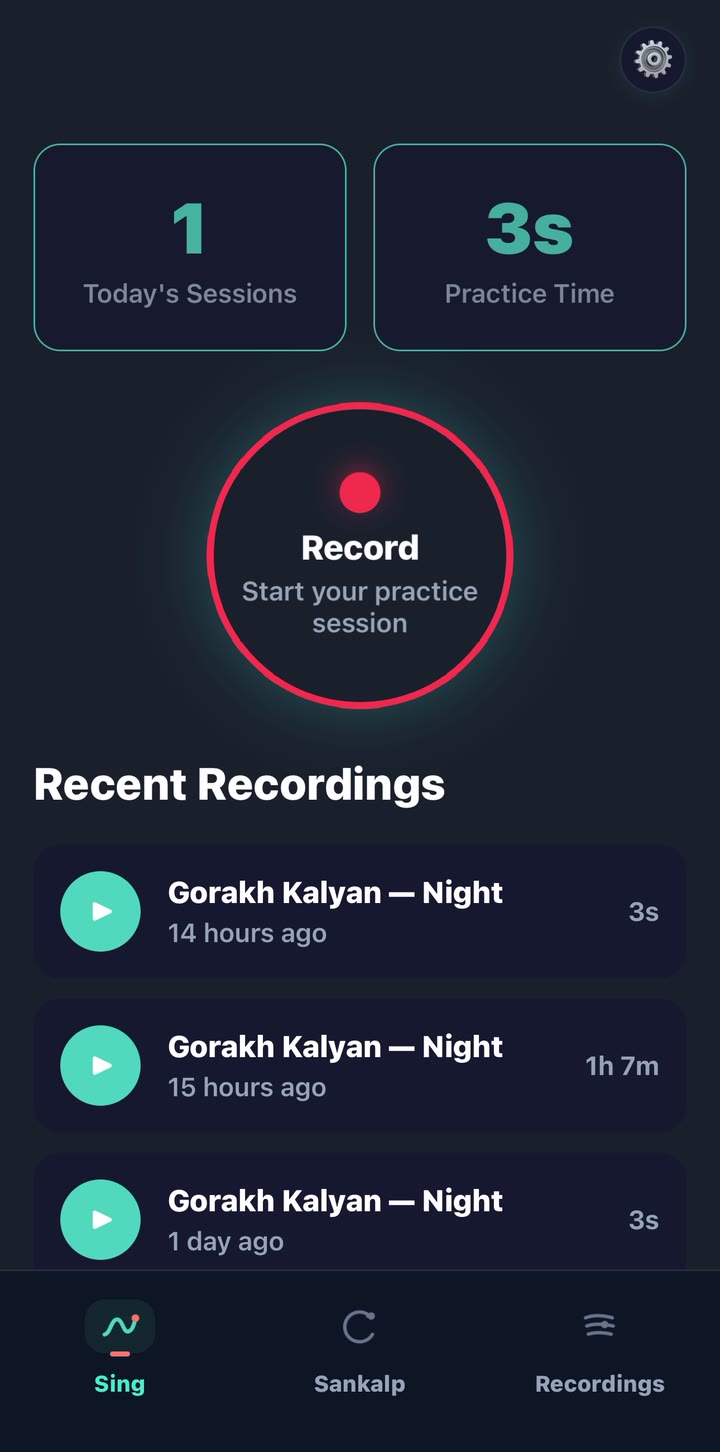
A Git repository for music
The earliest idea was almost like a Git repository for a musician’s practice.
In software, there is a latest version, but earlier versions are still there when you need to understand what changed. Music practice felt similar to me. Each sitting creates a new version: a phrase opens, an alaap changes, a difficult passage becomes clearer, or a question appears that I want to revisit.
The aim was to record the whole sitting, then find the moments that mattered without searching through an hour of audio: something worth remembering, something to rework, or a take worth keeping as the current performance version.
Practice creates versions. KalaPanion helps me remember what changed.
One sitting, kept whole
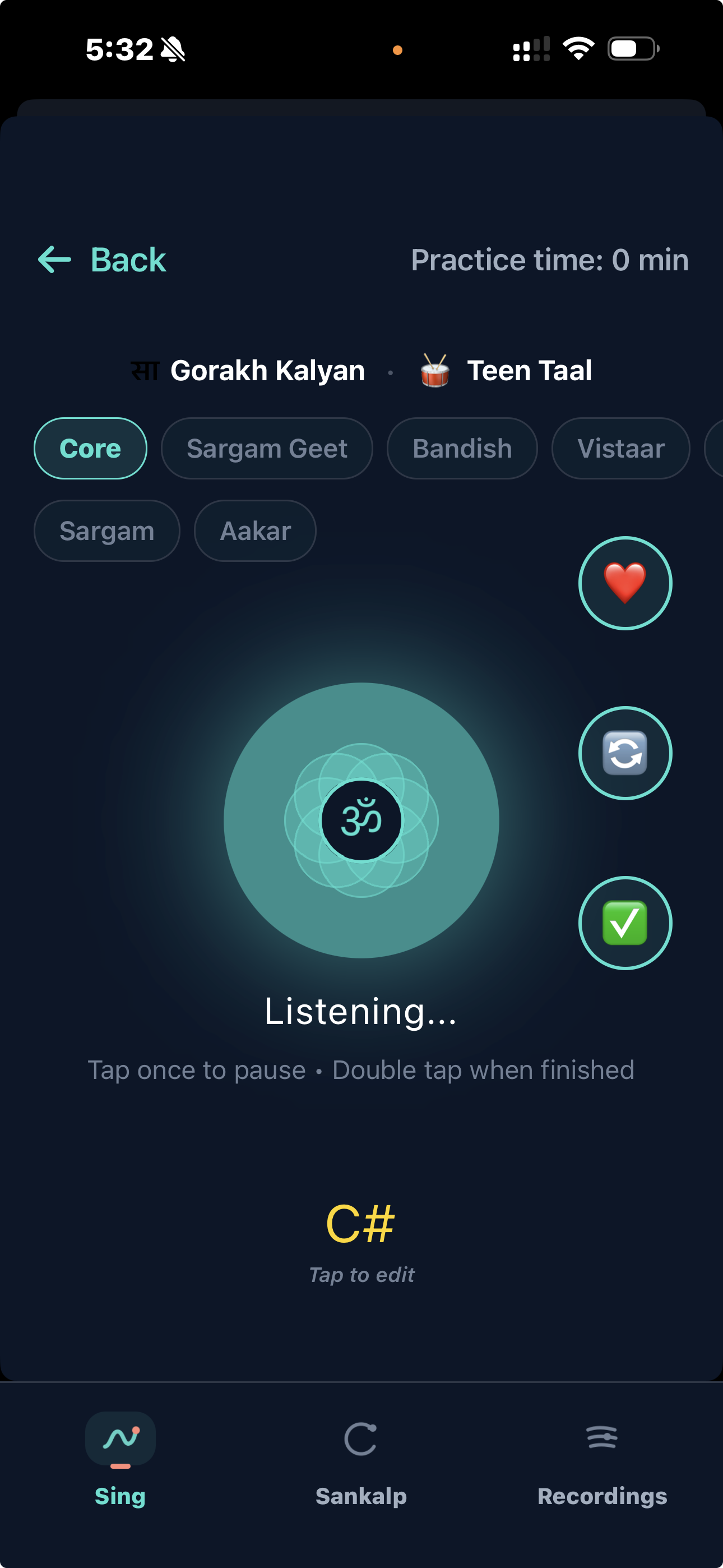
That became the center of KalaPanion: one continuous recording for the practice sitting.
While the music continues, Heart can mark a moment worth remembering, Rework can hold something to revisit, and Take can keep a promising version. The singing does not need to stop for an explanation.
Other parts of the practice gradually joined the same sitting: Aumkaar, Raag, Taal, pitch, and the musical area being explored. These pieces arrived one by one—not because they belonged on a feature list, but because they belonged in the practice.
After the music
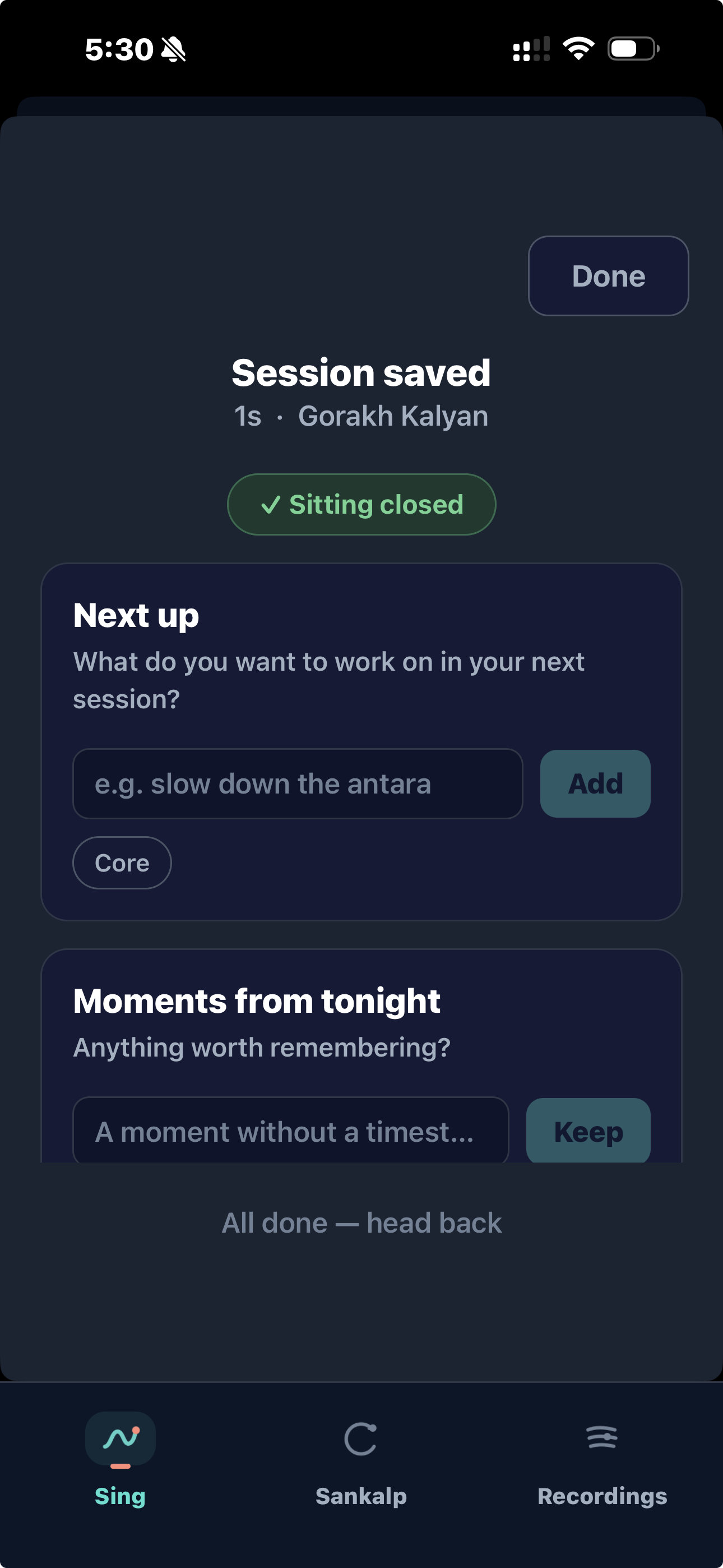
When the sitting ends, a different kind of attention becomes useful.
KalaPanion asks for a one-word close. A marked moment can receive a note, a reflection can be written or spoken, and an intention can be left for the next practice.
These are usually small thoughts: what opened, what felt difficult, what was heard, or what should carry forward. Putting them somewhere turns the app into a practice memory and leaves the mind freer to return to the music.
Sankalp: one intention for the week
A new Raag or song can feel like a mountain before the first step.
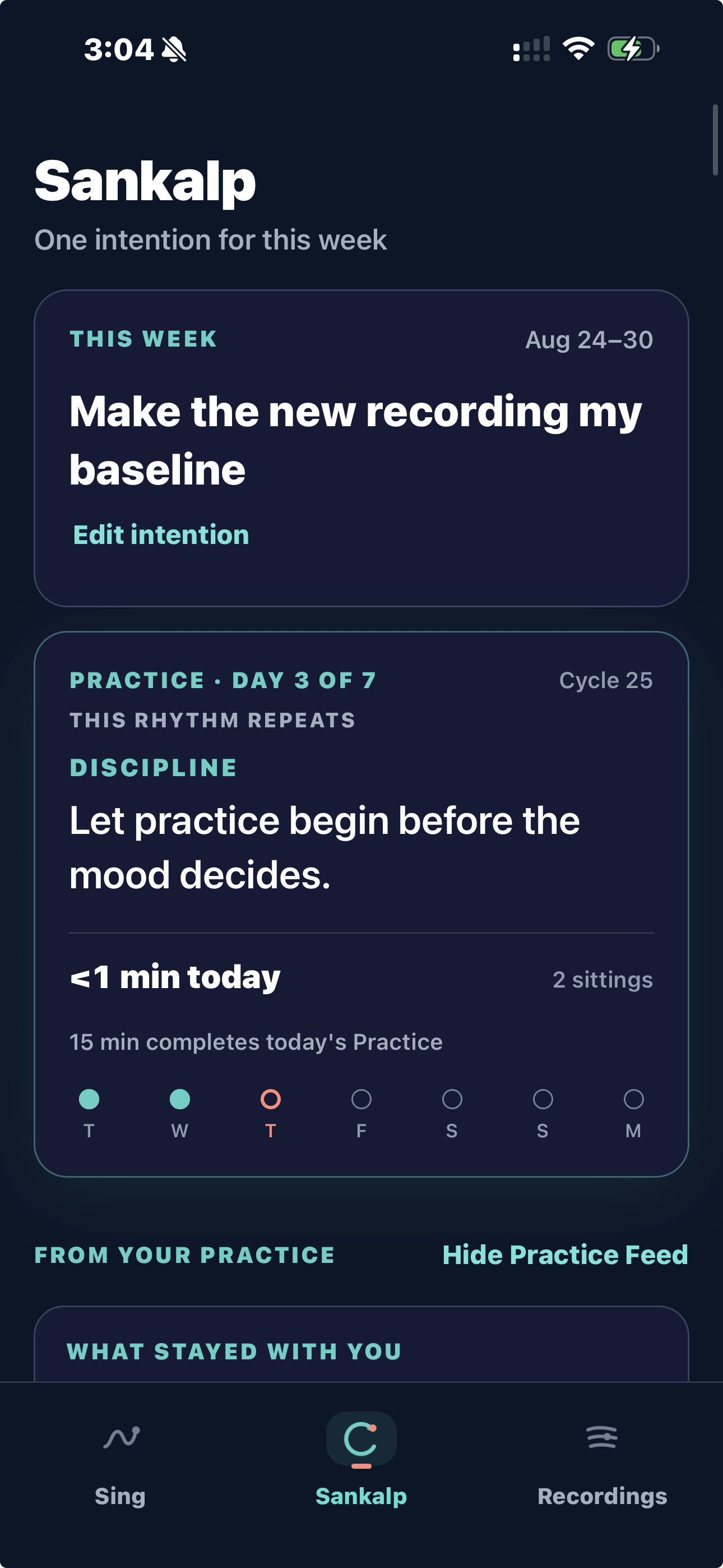
The product needed to support the process: one intention, one sitting, and then another return. Not forced discipline. Not a score. Just a little encouragement to keep a weekly rhythm and begin again after a gap.
That became Sankalp—an intention for the week. It gives the work a direction and makes showing up visible without pretending that every day or every practice will look the same.
A companion for the process
KalaPanion now stays with the practice before, during, and after the music: set an intention, record the sitting, mark what matters, reflect, and return later to what the practice produced.
None of this is technologically earth-shattering. But music practice—and Hindustani classical practice in particular—is a narrow space that most software is not designed around.
This is my humble attempt to make the app I wanted for myself, and to let the technology adapt to the way an artist works.
The name carries that intention: Kala—art—and Companion. A companion for your art.
Opening the conversation
This is very much a first version. Its next step is to leave private perfection behind.
More people can now use it, critique it, and help reveal what it could become.
The core feels strong enough to use. The next two or three releases are already taking shape: refinements to what exists, a more playful practice experience, and a few new ideas to explore.
AI-assisted development can shorten the path from thoughtful feedback to a focused improvement. It does not replace responsibility for the musical judgment, quality, privacy, or direction of the product.
KalaPanion can become a living conversation: shaped by the people who use it, by what continued practice reveals, and by what becomes possible through each iteration.
If the idea speaks to you, try it for one sitting and tell me what you notice. Consider KalaPanion a companion for your next practice session.
That conversation is where the next version begins.